The Legend of Zelda: Celebrating 40 Years
The Legend of Zelda video game was released in February 1986 for the Famicom in Japan.
In the early 1990s I was at a friend’s house for a neighborhood garage sell. We brought a few items to sale and we hung out for the day helping. To my surprise, my mother purchased a used NES along with a bunch of games which included The Legend of Zelda!
I remember spending some time playing it and being completely lost. This was before the internet or the existence of detailed strategy guides with pictures. However, a small paperback book, How to Win at Nintendo Games 4 (freely viewable on the Internet Archive), helped me unlock the secrets.
Here’s a look back at my previous Zelda MOCs in celebration of the 40th anniversary of The Legend of Zelda’s release.
In 2012, BrickCon was looking for a theme coordinate for the Art/Sculpture/Mosaic theme. I decided to volunteer. I also wanted to create a large MOC to include in the display that would fit with the theme. I ended up creating the largest build I have ever done, a map of the Hyrule overworld.

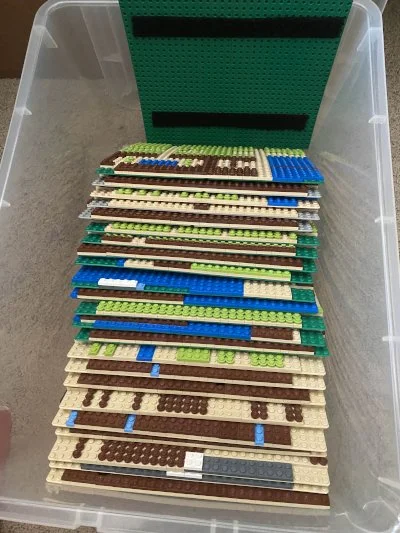
The map itself is twenty-four 32x32 stud baseplates with a layer of plates on top for the ground and water, then another layer of plates for details.
I placed velcro on the back of each baseplate to allow the map to be attached to a thin sheet of plywood in order to display. When assembled it is over 6.5 feet wide.
One stud represents 16x16 pixels. The map itself (without the bottom text) is 256 studs by 88 studs (each screen/section in-game is represented by 16x11 studs).
Since then I have attempted to build a few other MOCs based on the original Zelda game but only completed two.
For the 30th anniversary of the original Super Mario Bros. and The Legend of Zelda, Nintendo released Amiibo representing 3D 8-bit versions of Mario and Link, which I recreated with Lego in 2017.

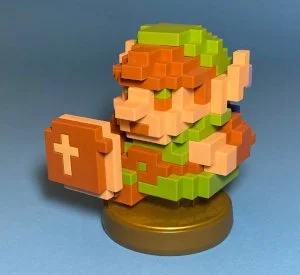
Inspiration: 3D 8-bit Link amiibo
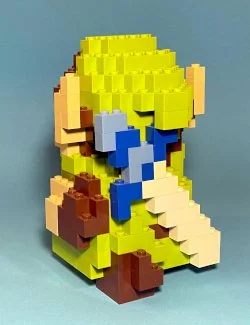
View from the back with the master sword
More recently, in 2022, I was trying to come up with an idea of 8-bit Link fighting one of the dungeon bosses. For simplicity I went with Dodongo and made some 8-bit bombs too.
I started by downloading sprites from The Spriters Resource. I then created a pixel grid to determine the dimensions.
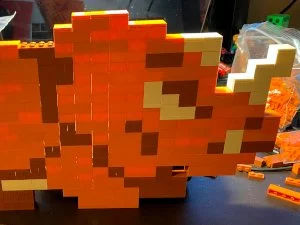
I was basically completed when I realized it looked off. I represented each pixel as two studs wide and four plates high when it should have been five plates high. 🤦
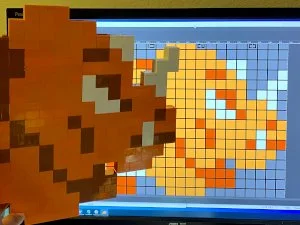
Comparison of the model and pixel grid for verification.
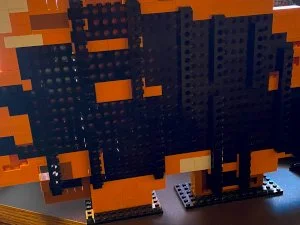
View of the back. The first version was built normally and two studs wide so it could be viewed from either side but easily fell apart when moved due to the height and not having much built-in structure due to the placement of bricks. In order to prevent it from breaking apart as easily, and not having enough bricks to make it wider to hide, I integrated technic bricks along with placing them vertically for added support.